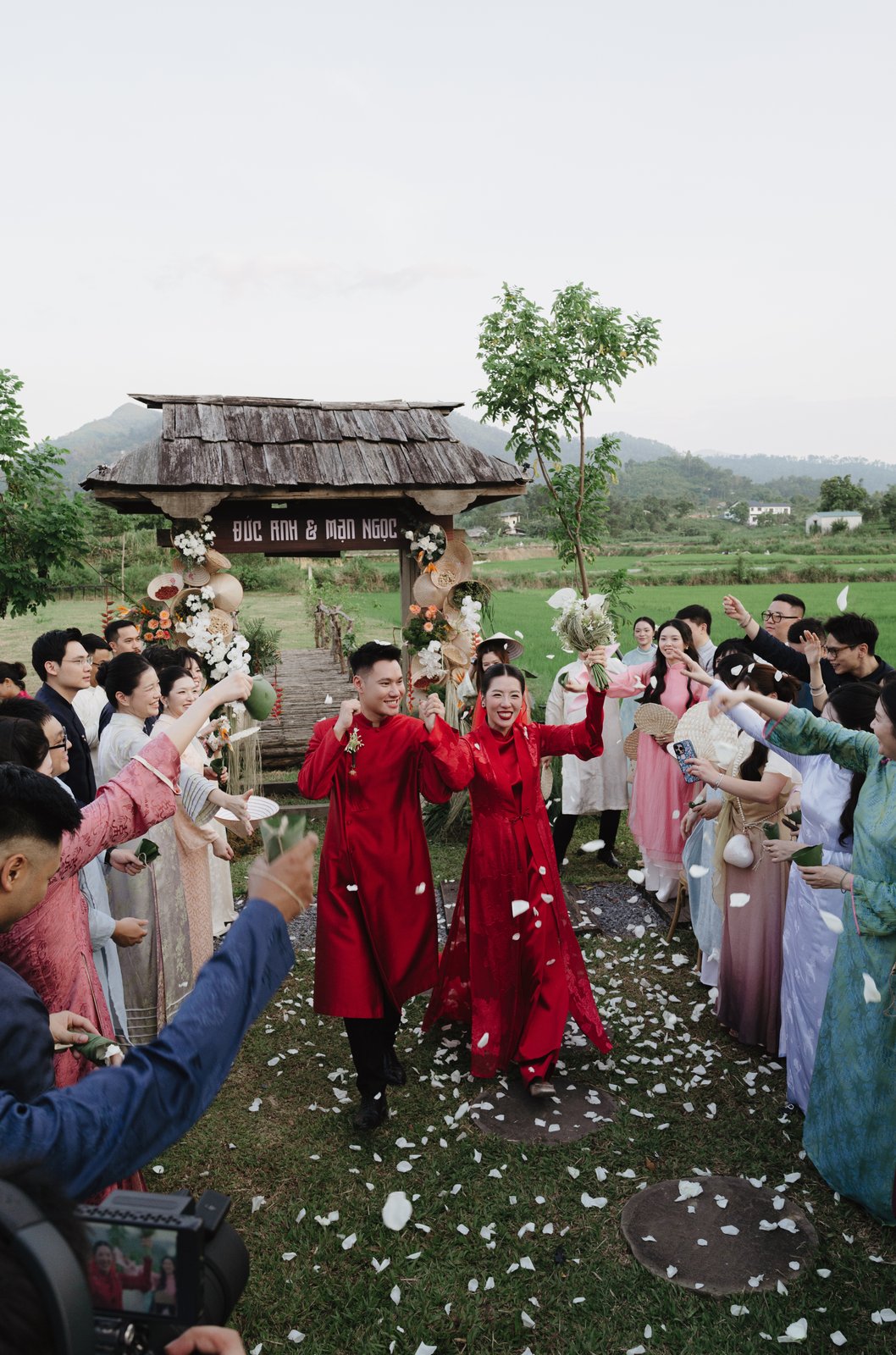
Three stages still matter: the engagement, dam hoi, where the groom's family brings gifts in red lacquer trays; the ceremony at the family altar on the morning, le gia tien, where the couple offer tea to their elders; and the evening banquet. The tea ceremony is short, private and the emotional centre of everything. If you photograph one thing, photograph that.
The shape of a Vietnamese wedding
A Vietnamese wedding is not one event. It is a sequence, spread over weeks or months, in which two families gradually become one. Western weddings put everything into a single afternoon. Here the weight is distributed, and the biggest moments happen in a living room rather than a venue.
The day itself begins at an hour chosen for luck, which is often before six in the morning. By the time an international guest has finished breakfast, half of the most important pictures already exist.
The engagement, dam hoi
Weeks or months before the wedding, the groom's family walks to the bride's home carrying mam qua: round red lacquer trays under red cloth. They are carried by unmarried young people from his side and received by the same number from hers, which is its own small ceremony and makes wonderful photographs.
Inside the trays: betel leaves and areca nut, tea and wine, cakes, fruit, and often a roast pig. The number of trays is agreed between the families beforehand, because the right number differs between the north and the south, and getting it wrong is the kind of thing people remember for thirty years.
The family altar and the tea ceremony
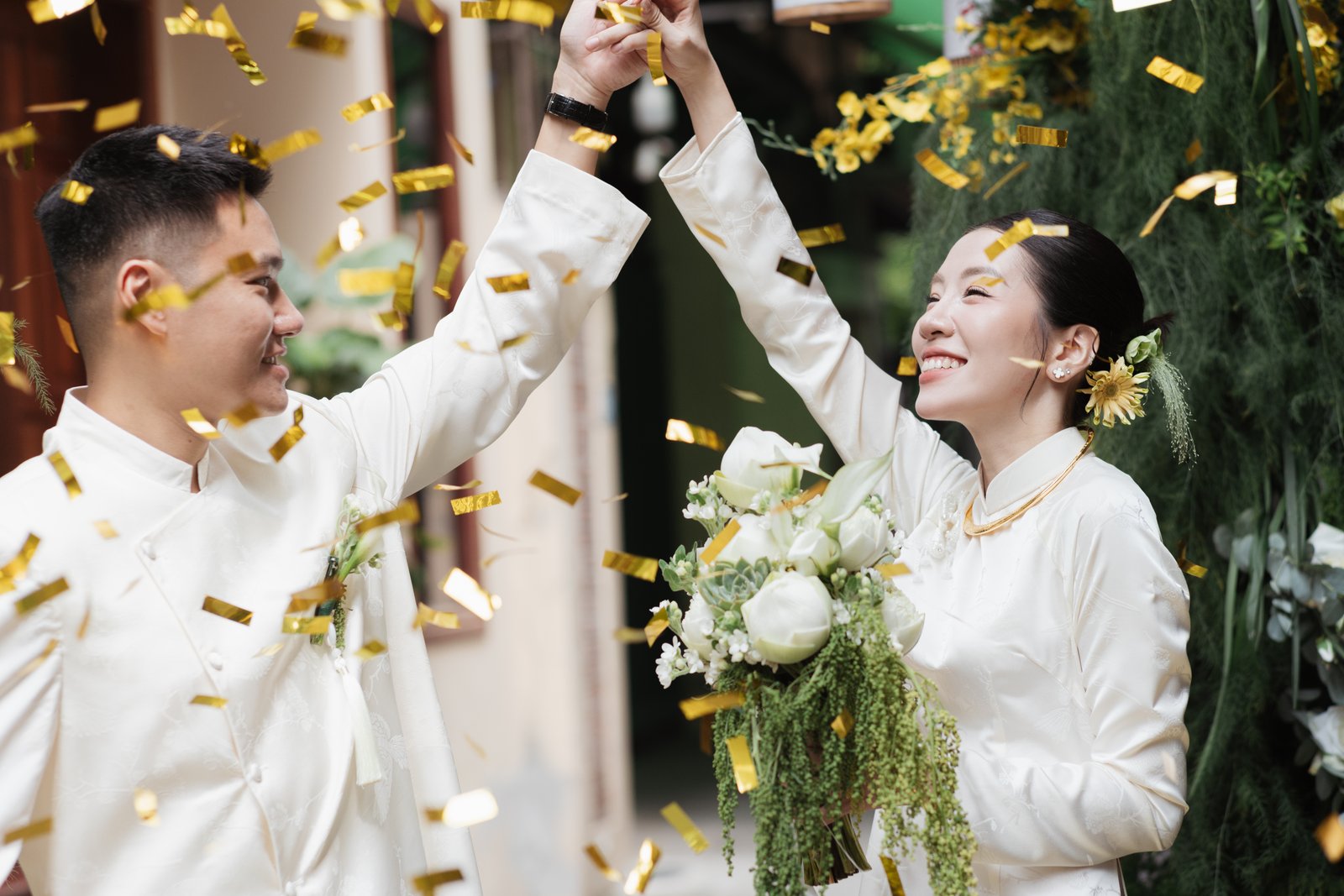
On the wedding morning, in front of the ancestral altar, the couple light incense, report the marriage to the family's ancestors, and offer tea to parents and elders with both hands. In return they receive blessings, advice that is sometimes very direct, and gold: earrings, a bracelet, a chain, placed on the bride by the women of the family.
It lasts twenty to thirty minutes. The room is small, usually crowded, and the light is whatever comes through the door. It is also where the mothers cry and the fathers give the speech they rehearsed in the kitchen. We shoot it quietly, with two cameras, without rearranging anyone.
The banquet
The evening banquet is the public part: several hundred guests, a long table-by-table walk for the couple, toasts, and a great deal of food. Guests give cash in a red envelope at the reception desk on the way in. It is loud, warm, and much less formal than a western reception.
Two practical notes. The couple often change outfits two or three times across the day, and the banquet runs on a schedule set by the restaurant, so the timings are tighter than they look.
If you are a guest, or marrying in
- Colours. Avoid white and black as your main colour. Red, gold, pink and jewel tones are all right.
- The envelope. Cash, red envelope, given at the desk. Ask someone in the family what is normal for this wedding rather than guessing.
- Shoes off when you enter a family home, and shoulders covered at the altar.
- Be early, not fashionably late. The auspicious hour is not a suggestion.
- Say yes to the food. Refusing a dish at a Vietnamese table takes more explaining than eating it.
If you are coming home from abroad
A large share of the couples we photograph grew up somewhere else and came back to marry: families in California, Texas, Paris, Berlin, Seoul, Tokyo, Taipei, Singapore. Two things come up every single time.
How much of the tradition do we keep? Our honest answer: keep the tea ceremony. It is short, it is the part your parents will watch again in twenty years, and it is the part that cannot be recreated anywhere else. Everything after that is negotiable.
How do we plan it from nine time zones away? The same way we plan every international booking: everything agreed in writing before you fly, a fitting in the week you arrive, and a team that speaks both languages so your parents can ask us questions directly rather than through you. That last part matters more than couples expect.