Register the marriage where you live, where the paperwork is in your language. Celebrate here. Keep the tea ceremony even if you let everything else go. Give yourself six months for a wedding day and four to eight weeks for a photo session, and use a team that speaks both languages so your parents can talk to us directly.
Why couples come back
A large share of the couples we photograph grew up somewhere else: California, Texas, Paris, Berlin, Seoul, Tokyo, Taipei, Singapore. Some have not lived in Vietnam since they were small. Some have never lived here at all.
They come back for two reasons, and the second one surprises them. The first is the grandparents, who cannot fly any more and whose presence at the altar is the whole point. The second is that the photographs taken here look like their family, in a way that photographs taken in a hotel ballroom at home never quite did.
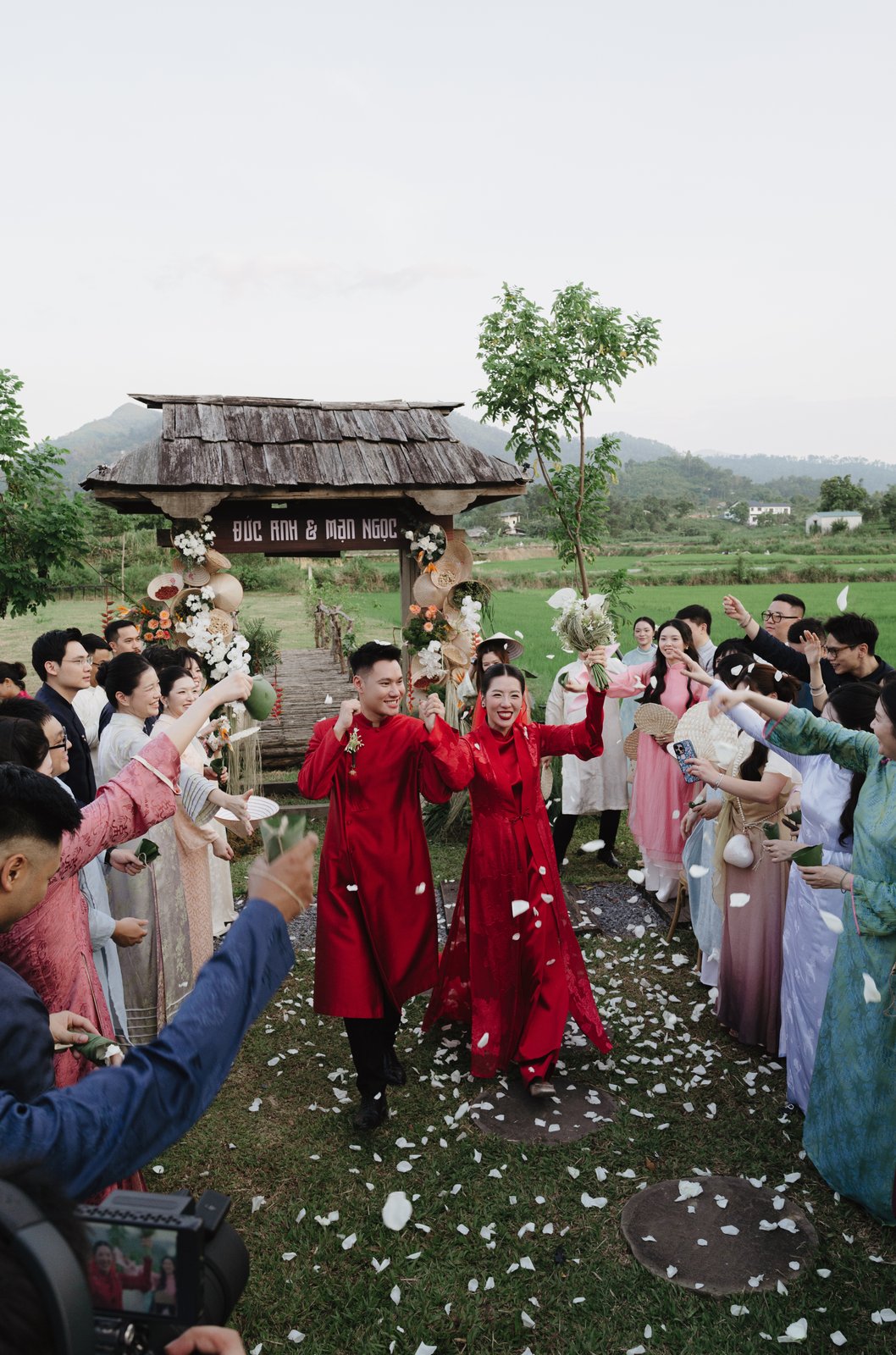
Two weddings, or one
The common pattern, and the one we would recommend: a small legal signing where you live, with the documents in your own language and no translation to arrange, then the real celebration in Vietnam.
It removes the hardest problem, which is paperwork across two legal systems, and it solves the other one too: the relatives who cannot travel. Your friends at home get the registry and dinner. Your family here gets the morning at the altar and the banquet.
If you want the Vietnamese marriage registered here instead, that is possible when one of you is a Vietnamese citizen. It is handled by the People's Committee where the Vietnamese partner lives, and the foreign partner needs a passport and a certificate of no impediment from home, usually valid for six months. Allow real time for translation and legalisation.
What to keep and what to let go
You do not have to do all of it, and you are allowed to say no. What we have watched work:
- Keep the tea ceremony. Twenty to forty minutes, at the family home, in front of the altar. This is the one.
- Keep one set of ao dai even if the rest of the day is western. The pictures change completely.
- Shorten the engagement. Families living abroad often merge the engagement into the wedding morning. This is already normal in southern Vietnam.
- Negotiate the banquet. Three hundred guests is traditional and exhausting. Smaller is increasingly common and nobody objects for long.
- Let go of the full procession if the two families are not in the same city. Nobody enjoys two hours in a convoy.
The conversation with your parents
This is the part nobody writes about, so we will. The friction is almost never about the wedding. It is about whether you still belong to the family in the way they hoped.
What helps: ask them to choose one thing that is non-negotiable, rather than negotiating item by item. Most parents name the altar, and once that is secure they are far more relaxed about the venue, the guest list and the dress. Give them the ceremony and they will usually give you the rest.
It also helps enormously if they can speak to the vendors themselves. Our team works in Vietnamese every day. We would rather have your mother call us directly than have you translate for three weeks.
Planning across nine time zones
| When | What to do |
|---|---|
| 6 months | Pick the week, taking Tet and the regional seasons into account. Hold the venue. Tell us the dates. |
| 4 months | Legal signing at home. Guest list agreed with both families, in writing. |
| 8 weeks | We plan the route, the hours and the team, and hold it with a USD 100 deposit. |
| The week you land | Fitting, trial if you want one, and a walk through the family home so we know where the light is. |
| The day | Start before six. Nobody is ever ready for this part. |
| After | Wedding day photographs in one week, a five to ten minute film, and an album your parents can hold. |
What it costs compared with home
A full wedding day with photography and film here is from USD 3,000, and a pre-wedding session is USD 780 to 1,480 depending on the city, complete, with hair, make-up, gowns and transport inside the price. For most couples living abroad, that is less than photography alone would cost at home, with a bigger team and more hours.
The flights are the real cost, and that is also the point: you were going to come home anyway.